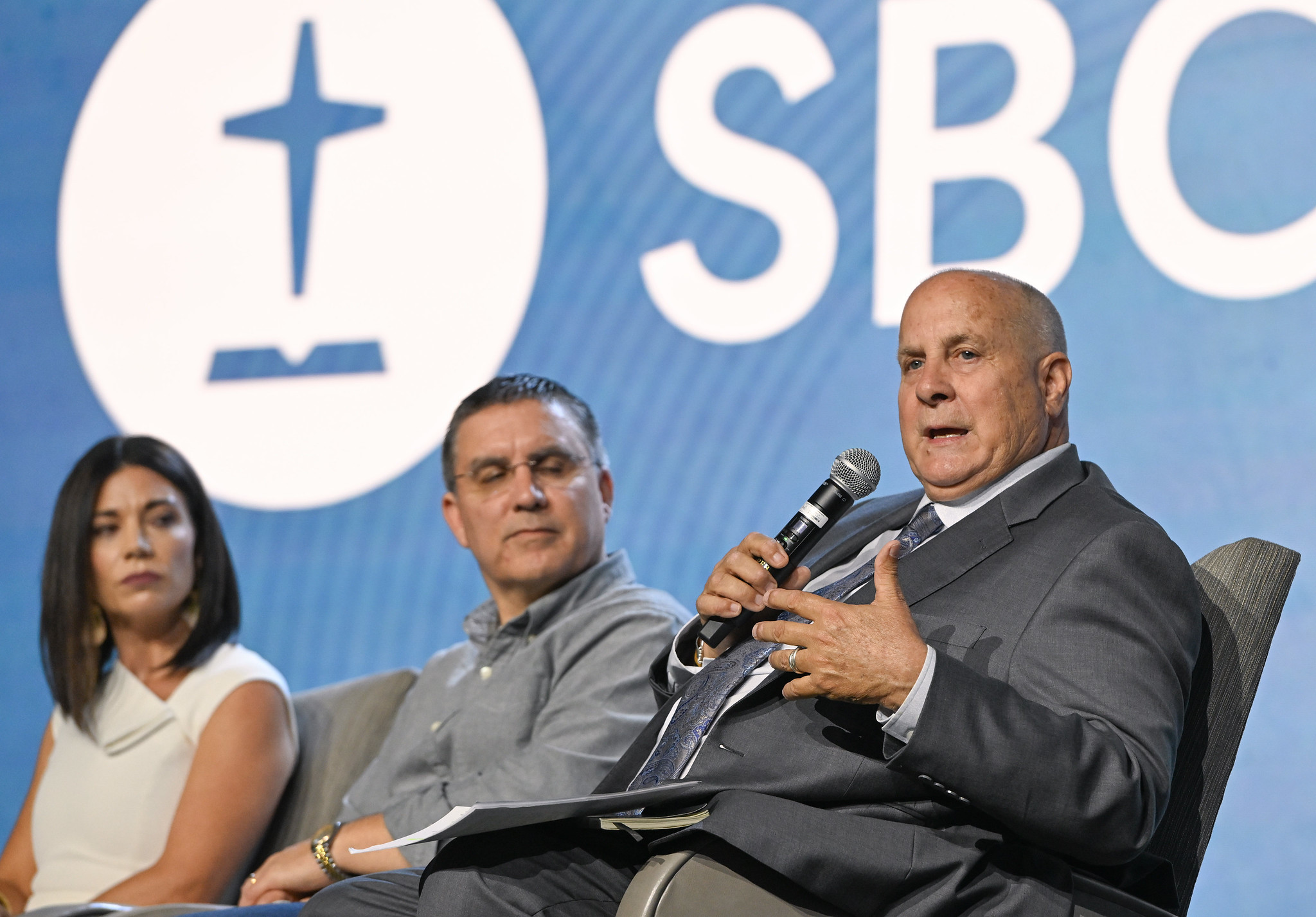
‘Don’t Leave Here and Do Nothing’: SBC Panel Calls Churches to Act on Child Exploitation

Born and raised in Central Florida, Robbie Harper is a sixth-generation Floridian and the founder of Blue Bridge PR, a firm dedicated to helping Christian businesses and nonprofits communicate with clarity, build trust, and strengthen their reputation. A graduate of Stetson University with both a bachelor’s degree and an MBA, Robbie began his PR career as a senior account executive representing large corporate law firms, securing national media coverage. In 2015, he launched Blue Bridge PR to serve leaders—especially faith-driven organizations—who want to be trusted voices in their communities. His work has earned national placements, including Forbes and The Wall Street Journal, and focuses on media relations, thought leadership and crisis communication planning. Robbie is active at Stetson Baptist Church in DeLand, Florida, where his wife, Nicole, serves as children’s minister. They live in DeLand with their three children.
State and federal officials, survivors, and ministry leaders gathered at the 2026 SBC Annual Meeting to move Southern Baptist churches from awareness to action on child abuse, sexual exploitation, and human trafficking.
ORLANDO — She was going to church the entire time it was happening.
That was the disclosure Olivia Littleton, senior director of Survivor Services for One More Child, made to a room full of Southern Baptist pastors and ministry leaders at the 2026 SBC Annual Meeting. A survivor of sexual exploitation herself, Littleton made the point with quiet precision: the children the Church is trying to protect may already be sitting in its pews.
“I want you to know that you are seeing these individuals already in your communities,” Littleton said. “That’s just the reality of our spaces.”
The moment captured what “Bearing His Image” set out to do. The 90-minute panel event, co-hosted by the SBC Executive Committee’s Abuse Prevention and Response department and One More Child on Monday, June 8, at the Rosen Centre Hotel in Orlando, was not designed to inform and release. It was designed to compel.
“We believe every person made in the image of God is worthy of respect, protection, and dignity,” said Jeff Dalrymple, the Executive Committee’s director of Abuse Prevention and Response, who opened the session. “When abuse and exploitation happen, it is a serious affront to Creator Almighty God.”
Moderated by Jodi Domangue, chief operating officer of One More Child, the panel brought together state and federal officials, survivor advocates, counselors, and frontline ministry leaders. Stephen Roberts, president and CEO of One More Child, opened in prayer, grounding the afternoon in Psalm 82:3-4: “Rescue the weak and the needy; deliver them from the hand of the wicked.”
The Problem Is Already in the Room
Before anyone could take action, they had to understand what they were acting against. The statistics the panel presented were not designed to overwhelm. They were designed to close the distance between “out there” and “in here.”
Taylor Hatch, Florida’s secretary of the Department of Children and Families, named the central misconception. “81% of children experiencing human trafficking are living at home,” she said. Those are the same children filling vacation Bible school seats and collecting backpacks at church supply drives, not strangers or abstractions.
Ashlee Lucas, anti-trafficking specialist with The Tebow Group, shared a map tracking approximately 340,000 IP addresses, each representing a device uploading and sharing child sexual abuse material on a single peer-to-peer network over just six months. Studies show 55% to 80% of people engaging with that material are hands-on offenders, with each offender averaging 13 victims.
Kevin Malone, a senior advisor on human trafficking at the U.S. Department of Health and Human Services, described a scaling crisis driven by technology. He cited online groups that target minors, grooming them into self-harm and, in some cases, suicide. “Our kids, unfortunately, with these devices are bringing predators into our homes,” Malone said.
Rachelle Starr, founder and president of Scarlet Hope and CEO of Freedom Signal, identified the two conditions predators exploit most: vulnerability and isolation. She noted that NCMEC reports of child enticement jumped from 298,000 to 518,000 between 2024 and 2025. “The predators are already there,” Starr said. “Unless we are warning kids about the signs and what to look for, they are vulnerable.”
Licensed professional counselor and author Julie Lowe pushed further. “Strangers aren’t dangerous,” she said. “Dangerous people are dangerous. 90% of kids who get abused are abused by people they know.” Predators, she explained, do not target children first. They target the adults those children trust. Brad Eubank, lead pastor of Petal First Baptist Church in Mississippi and a childhood abuse survivor, knew this firsthand. He recalled the moment his own abuser leaned over a church pew and complimented his mother on her sons.
“They have to groom the gatekeeper,” Eubank said. “My mom trusted him so that even if I ever did tell, she would doubt me over the predator.”
A Gospel Mandate, Not a Cultural Conversation
The panel was direct about why churches have been slow to engage. Eubank drew a comparison many in the room recognized. “I never heard the word abortion spoken in church growing up,” he said. “Fast forward 35 years. It is a normal conversation. We have crisis pregnancy centers and recovery groups.” The same normalization, he argued, must happen with abuse.
“It is a gospel issue because Jesus cared about children,” Eubank said. “He said it would be better to put a millstone around their neck and throw them in the ocean than to cause one of these little ones to stumble. Churches must be the safest place on the planet to protect children, and if it has already happened, the place survivors know they can go.”
The resistance to that shift, Lowe said, often comes from a theological misunderstanding about what the Church is protecting when it stays silent. “God created sex. God created it to be good. Satan wants to destroy it and make it evil,” she said. “If we are not talking to our kids about sex, we are not talking about abuse. And we are not talking well about it either.”
Hatch offered concrete evidence of what engagement produces. She pointed to Florida’s partnership with the CarePortal platform, which connects government-identified family needs with local church volunteers. Since 2019, the state has seen a 47% reduction in children entering out-of-home care, a statistic that outpaces national trends. “We cannot do this work in isolation,” Hatch said. “The only way you can go wrong is to do nothing.”
What Doing Something Actually Looks Like
The panel’s final turn was practical, and it was pointed. No one left those conversations without a clear on-ramp.
Littleton told the room that readiness must come before a survivor ever walks through the door. “Getting to the point of telling someone takes a whole lot of courage,” she said. “Your emotional reaction cannot be stronger than the survivor’s. Hold safe space, and then connect them quickly to trained experts.” Hatch reinforced the point on reporting: “You don’t have to have it all figured out. If you call the abuse hotline, a trained counselor walks you through the next step. The only way you can go wrong is to do nothing.”
Lucas urged every church leader in the room to start with one question: who in your congregation already cares about this? “Convene a meeting. Ask everybody that cares about this issue to come together and begin to pray,” she said. “Equip your people, and then you have the most diverse population in your body on a Sunday morning. Once they are equipped, they take it out and they multiply and they disciple.”
Starr’s organization, Scarlet Hope, has delivered more than 2 million meals to strip clubs and brothels nationwide and runs a digital outreach platform churches anywhere can plug into. “In any zip code, any city, any state, you have an exploitation problem,” Starr said. “And we have a solution for that.”
Lucas closed with the charge the event had been building toward all afternoon. “Whatever you do,” she said, “don’t leave here and do nothing.”
A Generation in Progress
Eubank offered a sober but hopeful assessment of where the SBC stands. The convention, he noted, is the only one with a dedicated abuse-prevention office at the national level. Progress has been made. But 75% of the SBC’s 47,000 churches have 100 members or fewer, and the work of culture change moves slowly.
“This is a generational change,” Eubank said. “A few years back, I felt like we had our head in the sand. We now have panels on this issue. We have an office. We have moved the football down the field.”
Littleton closed with a word that was less about progress and more about certainty. “We already know how this ends,” she said. “We are already victorious in this fight. Every day, survivors are exiting exploitation because there are people who care about this issue and are seeing them as individuals with dignity and value.”
Roberts summed up the calling that had framed the afternoon from its opening prayer. “As believers, we follow Christ’s example by pursuing justice and mercy for the vulnerable,” he said. “We all have a role to play.”
- Careful Grace: Integrating Offenders and Violent Criminals into Church
 One of the most frequent questions we receive from churches and ministry leaders is about integrating offenders into church. They wonder “Should we do it,” and “What are best practices as we carefully consider protection and stewardship.” We as pastors and ministry leaders know first hand that God is in the business of changing lives. No one, not even the worst of society’s criminals and offenders, is too far from the grace of God and the gospel. We know that the Lord can work in anyone’s life to bring redemption and salvation.
 - Fortify Initiative equips church leaders to protect, even as they build
 SPRINGFIELD, Tenn. – The Scripture verse printed on the front of a resource from the Fortify Initiative may not seem the most obvious choice for an effort focused on protecting the vulnerable. One might expect a verse about children or sheep. But the verse for Fortify is Nehemiah 4:17-18, which says that the men rebuilding Jerusalem’s walls carried their building materials in one hand and a weapon in the other. Verse 18 says, “Each of the builders had his sword strapped around his waist while he was building. …”
 - Practical virtual trainings help churches strengthen abuse prevention
 Abuse prevention in ministry can feel overwhelming, but free online webinars offered by the Southern Baptist Convention (SBC) Virtual Training Institute and MinistrySafe break complex safeguarding concepts into clear, actionable steps church leaders can implement today. The SBC Virtual Training Institute offers ministry leaders free, practical training designed to strengthen churches in safety, care, and responsible leadership.