‘When the Cute Factor Fades’: SBC Confronts a Gap in Disability Ministry That Leaves Vulnerable Adults at Risk

Born and raised in Central Florida, Robbie Harper is a sixth-generation Floridian and the founder of Blue Bridge PR, a firm dedicated to helping Christian businesses and nonprofits communicate with clarity, build trust, and strengthen their reputation. A graduate of Stetson University with both a bachelor’s degree and an MBA, Robbie began his PR career as a senior account executive representing large corporate law firms, securing national media coverage. In 2015, he launched Blue Bridge PR to serve leaders—especially faith-driven organizations—who want to be trusted voices in their communities. His work has earned national placements, including Forbes and The Wall Street Journal, and focuses on media relations, thought leadership and crisis communication planning. Robbie is active at Stetson Baptist Church in DeLand, Florida, where his wife, Nicole, serves as children’s minister. They live in DeLand with their three children.
A panel of disability ministry leaders, abuse-prevention experts, and people with lived experience gathered at the 2026 SBC Annual Meeting to call Southern Baptist churches to protect one of the most overlooked populations in their own pews.
ORLANDO — It starts, Shawn Thornton said, with what a father once described to him as the “cute factor.”
When a child with disabilities is 5, 7 or 8 years old, people in the church light up around them. They talk to them. They engage. There is something about a small child with a disability that draws the Church toward them. But as that child grows, the hormones kick in and the body changes, and the behavioral complexity of adolescence sets in. The cute factor, Thornton said, was gone. And with it, too often, goes the ministry.
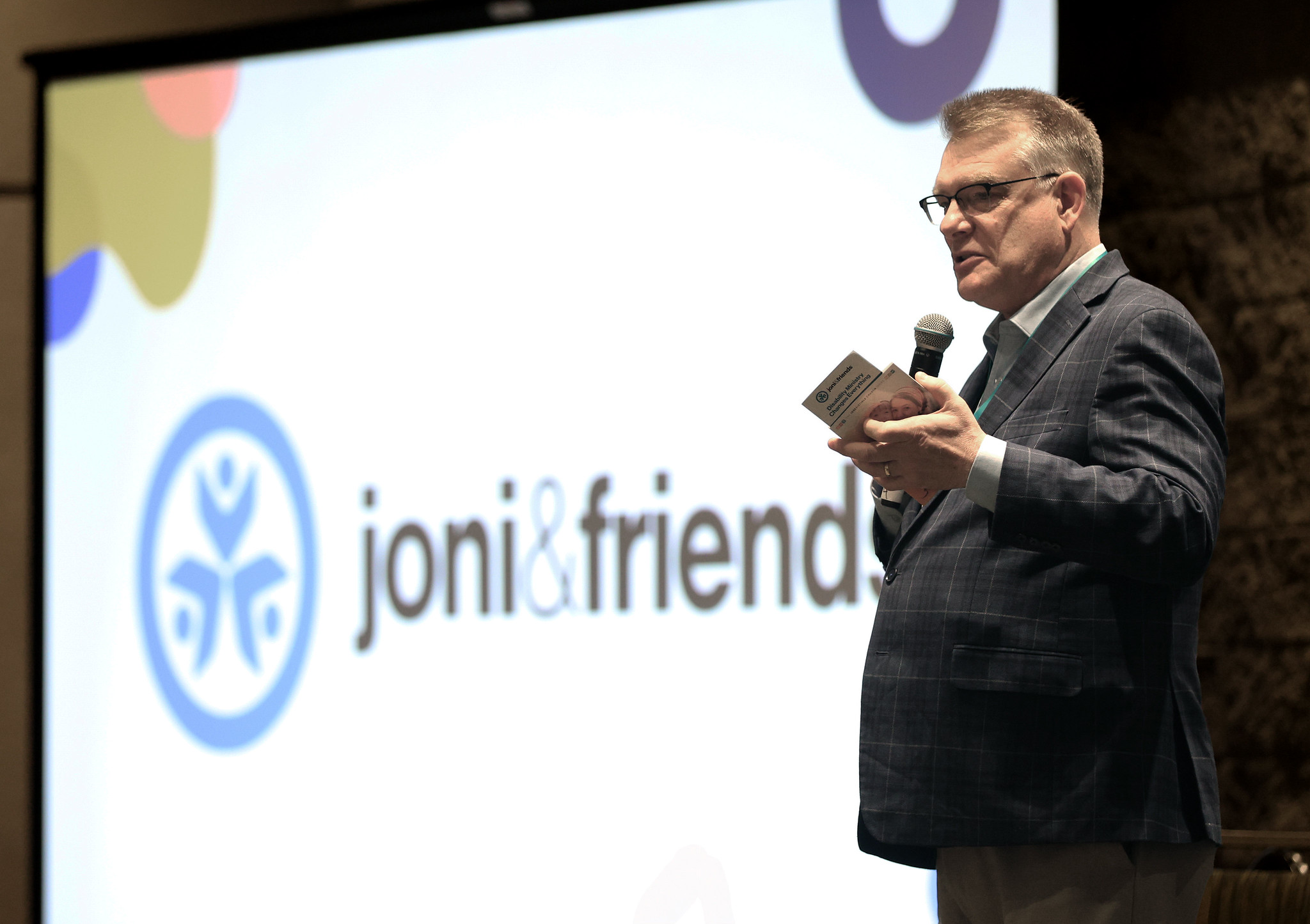
“The church just misses that opportunity to pick up right there and provide a supportive, healthy community,” said Thornton, president and CEO of Joni and Friends, who opened the Stand Up Lunch in prayer at the 2026 SBC Annual Meeting.
That observation set the frame for the 90-minute luncheon on Tuesday, June 9, at the Orange County Convention Center in Orlando. Hosted by the Evangelical Council for Abuse Prevention and sponsored by the SBC Executive Committee, Joni and Friends and the Baptist Convention of Maryland/Delaware, the event brought together disability ministry leaders, abuse-prevention specialists, a motivational speaker, an author and two fathers to confront what many families living with disability already know: the Church has more work to do.
The Statistics Behind the Urgency
Tom Stolle, executive director of the Baptist Convention of Maryland/Delaware, who moderated the panel, came to the issue through his son Jimmy, who is 24, nonverbal, and lives with significant developmental and intellectual disabilities.
“One of the things I discovered early on was the fact that he was extremely compliant,” Stolle said. “He would pretty much do anything anyone asked, which made him incredibly vulnerable.”
What Stolle found when he began researching the issue stopped him cold. He cited a study by Joseph Shapiro, reported by NPR in 2018, that found males with intellectual disabilities are 7 times more likely to be sexually assaulted than males without disabilities. For females, the number jumps to 12 times. For individuals with developmental disabilities broadly, the research indicates 90% will be sexually assaulted in their lifetime, with 49% assaulted 10 or more times.
“It takes your breath away,” Stolle said. “It’s not a matter of if for my son. It’s a matter of when.”
Jeff Dalrymple, the SBC Executive Committee’s director of Abuse Prevention and Response, connected those numbers to a deeper theological imperative. “We believe every person is made in God’s image,” he said, “worthy of dignity, respect and protection.”
The Transition Cliff
Thornton described what he watched happen at his own church in Southern California, located one exit from Joni and Friends headquarters. When the disability ministry launched 15 or 16 years ago, it drew mostly young children and their families. As those children aged into their late teens and early 20s, they began dropping out, because nothing existed for them.
His team responded by quietly starting something. A staff member invited two or three young adults with disabilities to come on a Tuesday for a Bible study, lunch and fellowship. They called it the Bible Street Boys. Then more people with disabilities joined. Then those same participants began serving alongside volunteers, distributing food to families in need. The guests coming for food started asking specifically for the Bible Street Boys to be the ones to bring it to them. Young adults who had come as participants in a disability ministry had become ministers themselves.
“The state of California proactively approved our program,” Thornton said. “They said, we really need this for young adults. Now we do it three days a week and it has dozens of participants involved. The body of Christ can be that place and that community.”
Stolle drew out the gospel distinction between that model and a secular day program. His own son attends one during the week, he said. “But what he doesn’t hear at the secular day program is about Jesus. And ultimately, compared to the amount of time he’s going to spend on earth, it’s a vapor. What he spends in eternity matters more.”
Why Existing Policies Are Not Enough
The panel did not stop at inclusion. It pressed hard into the question of safety, and the answer was direct: the protections most churches have in place were not designed for this population.
Kris Buckman, children’s and youth ministry consultant for the Baptist Convention of Maryland/Delaware, told the room that most abuse happens one-on-one, and disability ministry is full of one-on-one moments that standard child protection policies simply do not cover.
“You cannot assume that your safety policies, as they currently are, are sufficient for this community,” Buckman said. The two-person rule, a cornerstone of most church protection frameworks, breaks down constantly in disability ministry settings: sensory rooms, hallway walks during the service, bathroom assistance. Youth volunteers are frequently used as buddies without adequate training. And in the excitement of launching a new ministry, she said, churches routinely lose sight of screening.
“We need deeper background checks, scenario-based interview questions, thorough reference checks,” Buckman said. “These individuals are being given so much more trust. They need to be highly vetted at a much higher level.”
She was equally direct about the instinct to relax rules for trusted figures. “Policies should not be relaxed for anyone,” Buckman said. “Not the pastor, not the lead deacon. Most abuse is perpetrated by someone known and trusted.”
Sandra Peoples, disability ministry consultant for the Southern Baptists of Texas Convention and author of “Accessible Church,” offered the practical test: “We always want to err on the side of overprotection instead of ignoring red flags.”
She walked the room through warning signs in volunteers that churches often miss. Does a volunteer claim that only they can handle a particular participant? Do they ask about the person’s schedule, home address, or day program? Do they want to be available to the family outside church hours? “Trust your gut,” Peoples said. “If something feels off about a person, don’t be afraid to say something.”
She also described the indicators that a person with a disability may be experiencing abuse: reluctance to go to a particular person or setting, self-harm behaviors, or conversely, being overly eager to spend time with one specific individual. For nonverbal participants, she said, behavioral changes may be the only signal available. She spoke from experience. Her son James is 18 and functionally nonverbal. When he was in elementary school, she and her husband noticed he was coming home with signs that alarmed them. They brought their concerns to a church elder who was a mandated reporter. He contacted child protective services, an investigation followed, and a sexual assault nurse conducted an examination. No abuse was found. “We are first responders,” Peoples said. “We go with the information we have and trust the processes that are in place.”
An Unreached People Group in Our Own Pews
The most urgent frame the panel offered was not primarily about safety. It was about mission.
“So many of these families affected by disability are 100% what we consider an unreached people group within the SBC,” Thornton said. Research cited at the event suggests families of people with disabilities are significantly less likely to attend church regularly because of a lack of accessibility, programming or sense of belonging. The Church is not only failing to protect a vulnerable population. In many cases, it is failing to reach them at all.
Daniel Ritchie, an evangelist and author who is a member of The Summit Church in Raleigh, N.C., and who was completing his one-year term as first vice president of the SBC, put the theological weight of that plainly. “For the Church to push to the side those with disabilities is to cut off a section of the Church and say they don’t belong,” Ritchie said. “I do believe the Church itself is disabled if we don’t welcome in individuals affected by disabilities.”
Julie Lowe, a licensed professional counselor and author who has worked with families navigating disability for more than 25 years, said the response cannot be generic. “This is not a one-size-fits-all situation,” Lowe said. “Wisdom says we want to be aware of the vulnerabilities, aware of the needs, and thinking about where people can serve well, playing to their strengths rather than their weaknesses.”
Kathy Kovalchuk, special needs minister at Prestonwood Baptist Church in Plano, Texas, pushed back on the idea that welcoming someone with a disability is the end goal. “Inclusion is not the finish line,” she said. “It should be those starting blocks.” At Prestonwood, participants with disabilities serve as greeters, help with the offering, lead during kids’ events, and work in the preschool ministry.
She described a mother who dropped off her 19-year-old son at Vacation Bible School and walked to her car in tears. Kovalchuk followed her out to the parking lot. The mother turned and said: “I’ve never left Max anywhere. But I trust you.”
“She gave me the most precious gift God gave her,” Kovalchuk said. “And if that’s not the gospel, I don’t know what it is.”
The Convention Responds
The Stand Up Lunch was not taking place in a vacuum. During the same annual meeting, Southern Baptist messengers took two significant actions to back what the panel was calling churches toward.
Messengers adopted Resolution 4, which acknowledges that millions of Americans live with physical, intellectual, developmental, sensory, and mental disabilities and that many families caring for individuals with disabilities experience isolation, exhaustion, financial burdens and limited access to church participation. Affirming the equal worth and dignity of all people and citing Scripture’s teaching that all bear God’s image, the resolution urges SBC churches to develop or expand plans for inclusion, evangelism, discipleship, and care for persons with disabilities and their families.
Messengers also approved a new Disability Ministry Emphasis, proposed by a task force led by Stolle himself, which directs SBC entities to mobilize resources for disability ministry. The North American Mission Board is charged with developing evangelism tools to reach people with intellectual and developmental disabilities. The International Mission Board is tasked with reviewing its current exclusion of missionary families that have a member diagnosed with autism. Lifeway Christian Resources is directed to add a disability ministry specialist and expand its disability-related training materials.
The emphasis reflects what Stolle’s task force spent months documenting: the SBC’s 47,000 churches have largely left a reachable, vulnerable, and underserved population without a place of belonging and protection.
The ECAP Stand Up initiative, available at ecap.net/stand-up, is developing the first formal safety standards specifically for vulnerable adults in Christian ministry settings, in partnership with Joni and Friends and other disability ministries. The initiative is currently raising $40,000 to complete and publish the standards.
Stolle closed with a word from Matthew 20, where two blind men cry out to Jesus and are told by the crowd to be quiet. Jesus does not listen to the crowd. He hears the two. He sees the two. He stops for the two. And he heals the two. And Scripture says the two followed him.
“My hope for five years from now,” Stolle said, “is that we would see more of that in our churches: churches seeing those affected by disability, hearing them, stopping for them, including them in the life of the church, which includes both protecting them and giving them opportunities to serve.”
- Careful Grace: Integrating Offenders and Violent Criminals into Church
 One of the most frequent questions we receive from churches and ministry leaders is about integrating offenders into church. They wonder “Should we do it,” and “What are best practices as we carefully consider protection and stewardship.” We as pastors and ministry leaders know first hand that God is in the business of changing lives. No one, not even the worst of society’s criminals and offenders, is too far from the grace of God and the gospel. We know that the Lord can work in anyone’s life to bring redemption and salvation.
 - Fortify Initiative equips church leaders to protect, even as they build
 SPRINGFIELD, Tenn. – The Scripture verse printed on the front of a resource from the Fortify Initiative may not seem the most obvious choice for an effort focused on protecting the vulnerable. One might expect a verse about children or sheep. But the verse for Fortify is Nehemiah 4:17-18, which says that the men rebuilding Jerusalem’s walls carried their building materials in one hand and a weapon in the other. Verse 18 says, “Each of the builders had his sword strapped around his waist while he was building. …”
 - Practical virtual trainings help churches strengthen abuse prevention
 Abuse prevention in ministry can feel overwhelming, but free online webinars offered by the Southern Baptist Convention (SBC) Virtual Training Institute and MinistrySafe break complex safeguarding concepts into clear, actionable steps church leaders can implement today. The SBC Virtual Training Institute offers ministry leaders free, practical training designed to strengthen churches in safety, care, and responsible leadership.